The 2025 Guide to Functional Fitness Training
(Part 1/2: Essentials & Movements)
Table of Contents
Tired of workouts that build muscle but don’t actually make life easier?
Here’s what most people miss: you can deadlift 300 lbs and still throw out your back picking up groceries. Traditional gym routines isolate muscles, but real life demands coordination—bending, twisting, lifting, and stabilizing all at once.
That’s where functional fitness comes in.
(This is Part 1 of our guide. If you’re ready for the full 12-week workout, click here.)
The Problem with Conventional Training
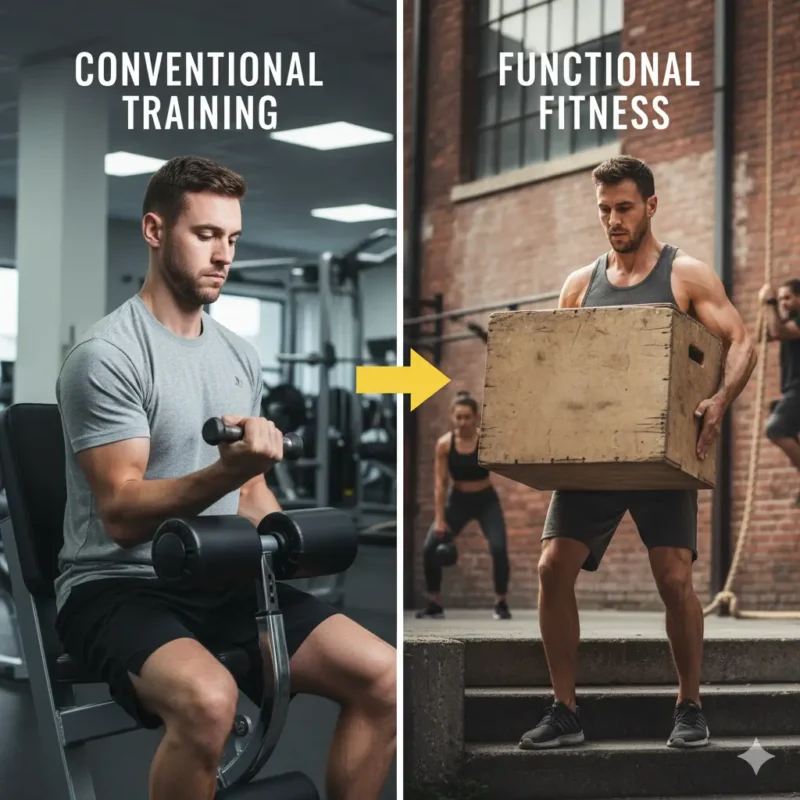
Spend an hour at the gym doing chest presses and leg extensions, then struggle to carry your suitcase upstairs. Sound familiar? Isolated exercises build strength that doesn’t transfer to real-world movement. Your body doesn’t work in isolation—so why train it that way?
Functional fitness training trains movement patterns, not just muscles. It’s why a 60-year-old who does functional training can move better than a 30-year-old bodybuilder.
What You’ll Learn in This Guide
After researching dozens of training protocols, interviewing certified trainers, and analyzing peer-reviewed studies, I’ve distilled functional fitness into its essentials:
Why Trust This Guide?
I’m not a celebrity trainer or Instagram fitness guru. I’m someone who spent 6 months deep-diving into the science of functional fitness training because I was tired of conflicting advice. This guide synthesizes research from physical therapists, strength coaches, and longevity experts into one practical roadmap.
Every exercise recommendation is backed by research. Every equipment suggestion has been tested and reviewed by real users. No hype, no shortcuts—just what works.
The Equipment Advantage
Here’s the good news: functional fitness doesn’t require a $2,000 home gym. With three key pieces of equipment—a quality kettlebell, resistance bands, and a stability ball—you can perform 90% of functional exercises at home.
Throughout this guide, I’ll show you exactly which equipment delivers the best value and performance, based on extensive testing and user feedback.
Ready to build strength that actually matters? Let’s begin.
Why Functional Fitness is Essential
Functional fitness isn’t just another training trend—it’s how your body was designed to move. Here’s what makes it fundamentally different from traditional gym workouts.

It Mirrors Real-Life Movement
Think about your daily activities: lifting a toddler, carrying groceries, climbing stairs, reaching for something on a high shelf. Every single one requires multiple muscle groups working in coordination.
Traditional gym exercises isolate muscles. Functional fitness training integrates them.
The difference:
When you train movements instead of muscles, everything from playing with your kids to preventing falls becomes easier and safer. This is the core promise of functional fitness training.
This is why investing in versatile equipment like adjustable kettlebells or resistance band sets makes sense—one tool, dozens of functional movement patterns.
It Dramatically Improves Quality of Life
Research from the American College of Sports Medicine shows that functional training significantly improves:
You’re not just building strength for the gym. You’re building capacity for life.
Real-world benefit: Better functional fitness means less reliance on others as you age. Independence isn’t just about finances—it’s about being able to move, lift, and function without assistance.
It Builds Resilient, Injury-Resistant Bodies
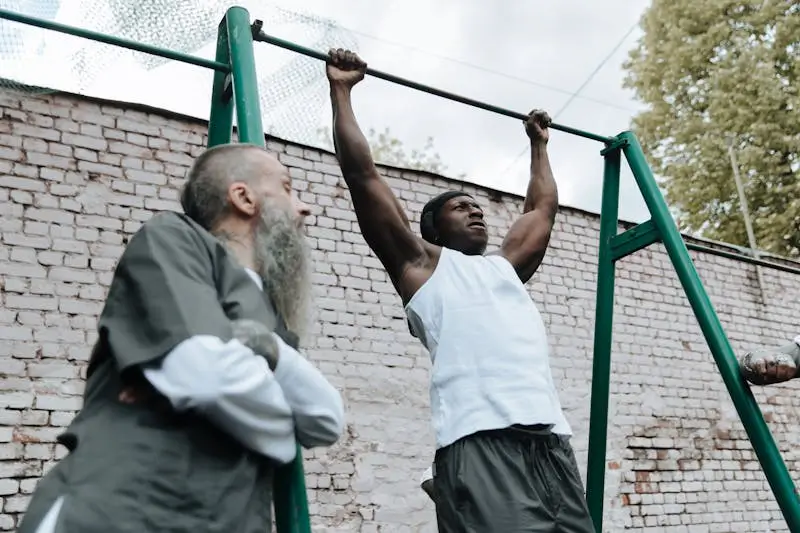
Here’s a sobering stat: 80% of gym injuries come from poor movement patterns, not from lifting too much weight.
Functional fitness fixes movement patterns first. By strengthening muscles in the way they naturally work together—and by training stabilizer muscles that traditional exercises ignore—you create a body that can handle stress without breaking down.
Key advantages:
Physical therapists increasingly recommend functional exercises for rehabilitation because they address the root cause of injury: poor movement quality.
Pro tip
A stability ball isn’t just for core work—it forces your body to recruit stabilizer muscles during every exercise, building the resilience that prevents injuries.
The Core of the Subject: Movement Over Muscles
Traditional bodybuilding asks: “Which muscle am I working?”
Functional fitness asks: “Which movement am I mastering?”
This shift in perspective changes everything. Instead of thinking “chest day” or “leg day,” you think in terms of:
Master these six movement patterns, and you’ve covered 90% of human physical capability.
The beauty? You don’t need a cable machine forest or a rack of dumbbells. A single kettlebell can address all six patterns effectively.
Building Strength That Lasts
Muscle built through isolation exercises looks impressive but degrades quickly without constant maintenance.
Functional strength is different. Because it’s neurological as much as muscular—teaching your nervous system to coordinate complex movements—it’s more “sticky.” Your body retains functional adaptations longer.
Studies on aging athletes show that those who practiced compound, functional movements maintained strength and mobility decades longer than those who focused on isolation work.
The longevity factor: Functional fitness isn’t about peak performance at 25. It’s about being capable at 65, 75, and beyond. It’s the difference between needing a walker and hiking with your grandkids.
Essential Functional Exercises: Your Complete Arsenal
These aren’t random exercises—they’re the fundamental movement patterns of functional fitness training that build real-world strength.. Master these, and you’ll have a body that performs as good as it looks.
The 5 Core Movement Patterns
Before we dive into specific exercises, understand that every functional movement falls into one of five categories. Train all five, and you’ve covered everything your body needs.
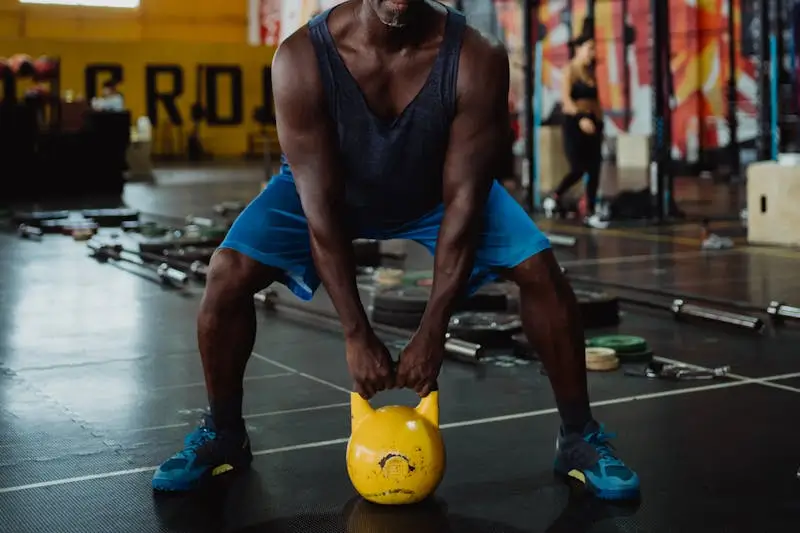
1. Squats: The Foundation of Lower Body Strength
Why it matters: Every time you sit down, stand up, or pick something off the ground, you’re squatting. It’s the most fundamental human movement pattern.
Primary benefits:
Goblet Squat (Beginner-Friendly)
How to perform:
- Hold a kettlebell or dumbbell at chest height, elbows pointed down
- Feet shoulder-width apart, toes slightly out
- Lower down as if sitting in a chair, keeping chest up
- Descend until thighs are parallel (or deeper if mobile)
- Drive through heels to stand
Coaching cues:
Sets/Reps: 3 sets of 10-12 reps
Equipment note
A 25-35 lb kettlebell is ideal for most beginners. The wide handle makes it easy to grip at chest level, and the compact design allows for a natural squatting position without equipment getting in the way.
Bulgarian Split Squat (Intermediate)
Why it’s essential: Unilateral (single-leg) training fixes strength imbalances and builds incredible leg stability.
How to perform:
- Place rear foot on a bench or stability ball (12-18 inches high)
- Front foot steps forward 2-3 feet
- Lower down until front thigh is parallel
- Drive through front heel to return
- Complete all reps on one side before switching
Sets/Reps: 3 sets of 8-10 reps per leg
The stability ball adds an extra balance challenge—your rear foot becomes unstable, forcing deeper core and stabilizer engagement.
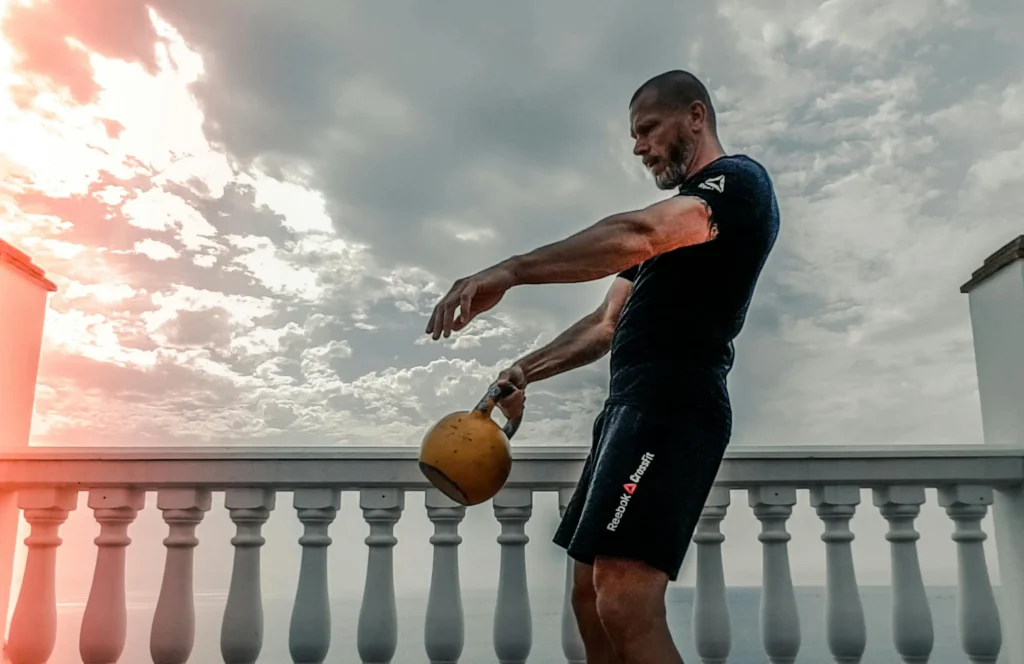
2. Hinges: Mastering the Posterior Chain
Why it matters: The hinge pattern (bending at the hips while keeping your back straight) protects your spine and builds the most powerful muscles in your body—your glutes and hamstrings.
Kettlebell Deadlift (Beginner)
How to perform:
- Kettlebell on floor between feet, feet hip-width
- Hinge at hips (push butt back), slight knee bend
- Grip kettlebell with both hands, arms straight
- Chest up, shoulders back, neutral spine
- Drive through heels, squeeze glutes to stand
- Reverse the movement with control
Coaching cues:
Sets/Reps: 3 sets of 10-15 reps
Kettlebell Swing (Intermediate to Advanced)
The king of functional exercises. Swings build explosive hip power, torch calories, and improve cardiovascular conditioning—all in one movement.
How to perform:
- Kettlebell on floor, slightly in front of you
- Hinge and grip with both hands
- Hike the kettlebell back between legs (like snapping a football)
- Explosively drive hips forward, swinging kettlebell to shoulder height
- Let momentum carry it—arms are just ropes
- Control the descent and repeat
Sets/Reps: 3-5 sets of 15-20 reps
Critical: This is a HIP movement, not an arm exercise. The power comes from the explosive hip snap. A quality 35-53 lb kettlebell (men) or 18-35 lb (women) provides the right resistance for powerful swings without compromising form.
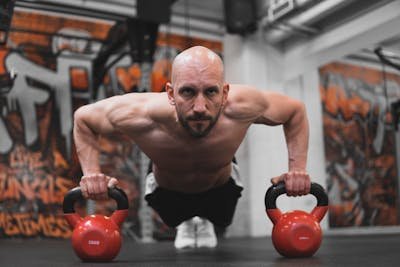
3. Push Patterns: Upper Body Strength
Push-Up Variations
Standard Push-Up:
- Hands slightly wider than shoulders
- Body in straight line (plank position)
- Lower chest to floor, elbows at 45-degree angle
- Press back up explosively
Sets/Reps: 3 sets of 8-15 reps
Progressions:
- Easier: Hands elevated on bench or wall
- Harder: Feet elevated, or add a resistance band across your back
A set of resistance bands offers infinite progression options—loop one across your back for added resistance, or attach to an anchor point for assisted push-ups
Overhead Press (Standing)
Why standing matters: Unlike seated presses, standing engages your entire core and teaches full-body tension.
How to perform:
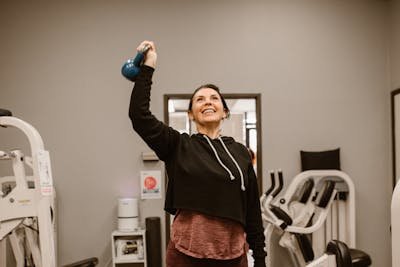
- Kettlebell or dumbbells at shoulder height
- Feet hip-width, core braced
- Press weight straight overhead
- Lock out arms, biceps by ears
- Lower with control
Sets/Reps: 3 sets of 8-10 reps
4. Pull Patterns: Build a Strong Back
Why it matters: Most people are “push dominant” (too much chest, not enough back). Pulling exercises fix posture, prevent shoulder injuries, and build functional strength.
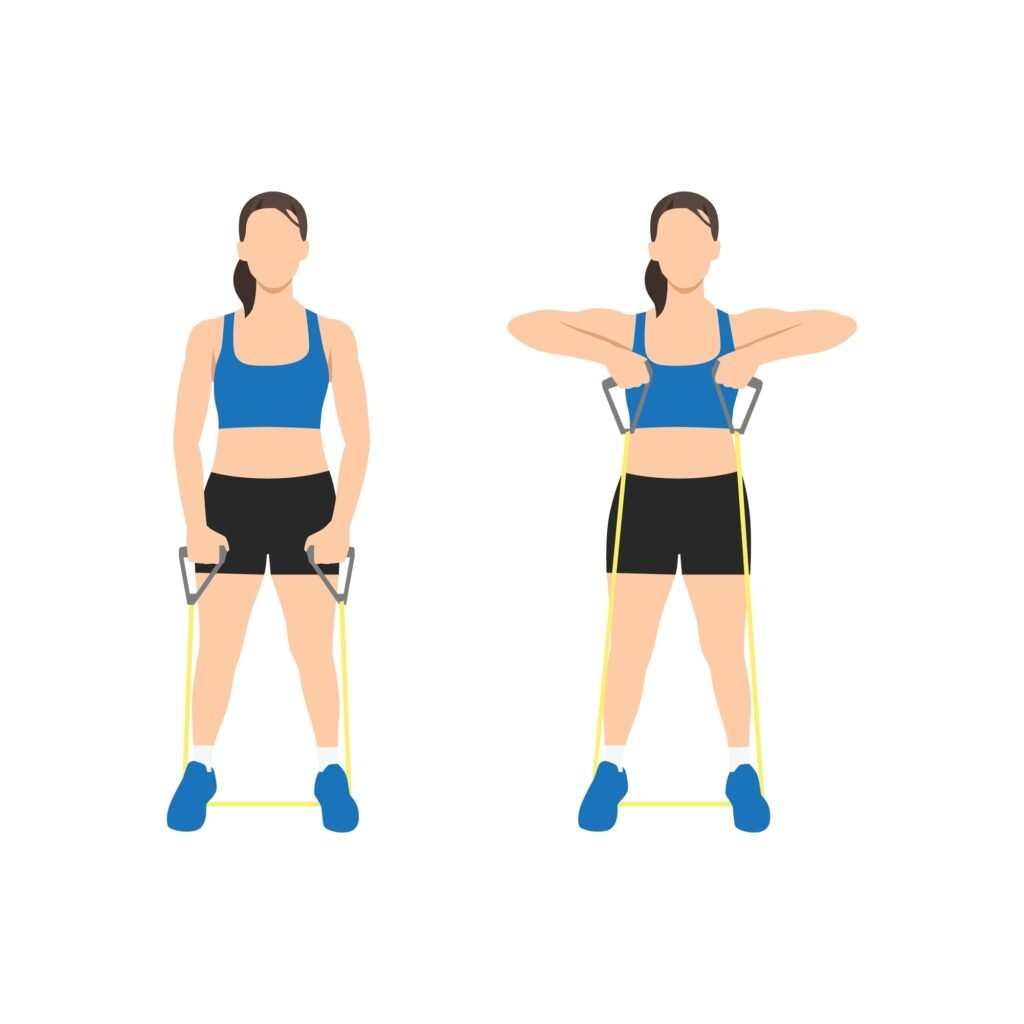
Resistance Band Rows
How to perform:
- Anchor band at chest height (door anchor or sturdy post)
- Hold handles, arms extended, step back for tension
- Pull handles to sides of ribcage, squeeze shoulder blades
- Slow return to start
Sets/Reps: 3 sets of 12-15 reps
A resistance band set with door anchor is one of the best investments for home training—portable, versatile, and joint-friendly. Look for sets with at least 4-5 resistance levels.
Inverted Row (Advanced)
Use a bar, TRX straps, or even a sturdy table. Body stays straight, pull chest to bar. Incredible for building pulling strength without needing a pull-up bar.
Sets/Reps: 3 sets of 6-10 reps

5. Core & Rotation: The Power Center
The truth about core training: Crunches are useless for functional fitness. Your core’s job is to resist movement (anti-rotation, anti-extension) and transfer force.
Plank Variations
Standard Plank:
- Forearms on ground, body straight
- Squeeze glutes, brace core
- Don’t let hips sag or pike up
Hold: 3 sets of 30-60 seconds
Progression: Stability Ball Plank
- Forearms on stability ball instead of floor
- The instability forces deeper core activation
Stability Ball
A quality stability ball (65cm for most adults) transforms basic exercises into serious core challenges. It’s also excellent for mobility work and stretching.
Dead Bug
How to perform:
- Lie on back, arms straight up, knees bent at 90°
- Slowly lower opposite arm and leg toward floor
- Keep lower back pressed to floor (no arching)
- Return and switch sides
Sets/Reps: 3 sets of 10 reps per side
This teaches core stability better than 100 sit-ups.
Your Minimal Equipment Essentials
To perform every exercise in this guide effectively, you need just three things:
Quality Kettlebell (or adjustable set)
Resistance Band Set with Door Anchor
Stability Ball (65cm or 75cm)
What you get: A complete functional fitness gym that fits in a closet.
Investment: 80-150 total for quality equipment that lasts years.
Our Top 3 Gear Recommendations

- 【FULL HOME GYM SET】Get more value in one kit with 5 resistance bands, 2 foam handles, 1 door anchor, 2 ankle straps, and…
- 【ADJUSTABLE UP TO 150 LB】Train at your level with 5 resistance options from 10 LB to 50 LB, or stack bands up to 150 LB …
- 【MORE EXERCISES, MORE RESULTS】Switch between handles, straps, and the door anchor to target arms, chest, back, glutes, l…

- EVERYTHING YOU NEED, RIGHT OUT OF THE BOX: The LifePro Horizon half balance ball trainer comes with an air pump, 10″ Pil…
- STEADY FOOTING, EVERY REP: Our textured non-slip half exercise ball measures 23.6″ wide — roomy enough for confident, st…
- BUILT TO LAST, BACKED FOR LIFE: Handles up to 440 lbs on a sturdy PP/TPE base — perfect as a half yoga ball for stretchi…
- Cast Iron
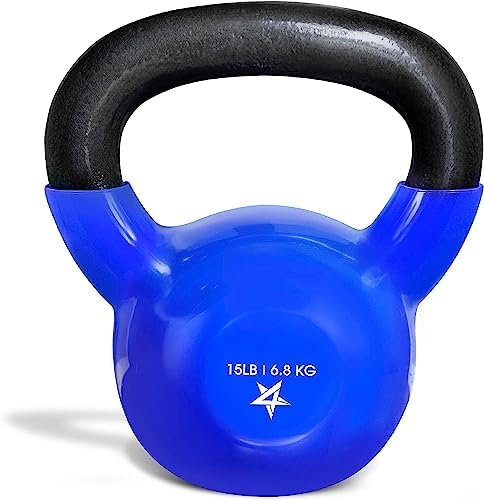
- CONFIDENCE IN EVERY LIFT: Unlike welded kettlebells that can loosen over time, one-piece solid cast iron delivers lastin…
- FLOOR-FRIENDLY TRAINING: Durable vinyl coating reduces noise and protects floors from impact for smoother indoor or outd…
Next Step: Your 12-Week Progressive Program (Part 2)
You have mastered the why and the what. Now it’s time for the how. In Part 2, we dive into the complete, progressive 12-week program, structured to take you from a complete beginner to an intermediate functional athlete, using only the equipment listed above.